SPF insulation offers a wide range of benefits whether used as a retrofit application in existing buildings or in new build applications and when installed correctly will last the lifetime of the building. In addition, SPF products tend to be easily installed by a professional installer and require minimal maintenance. No energy and resources are needed to ensure their continued functionality during their lifetime.
PU is one of the most thermally efficient insulation materials available and plays a vital role in improving the thermal performance of buildings.
Air leakage and air quality:
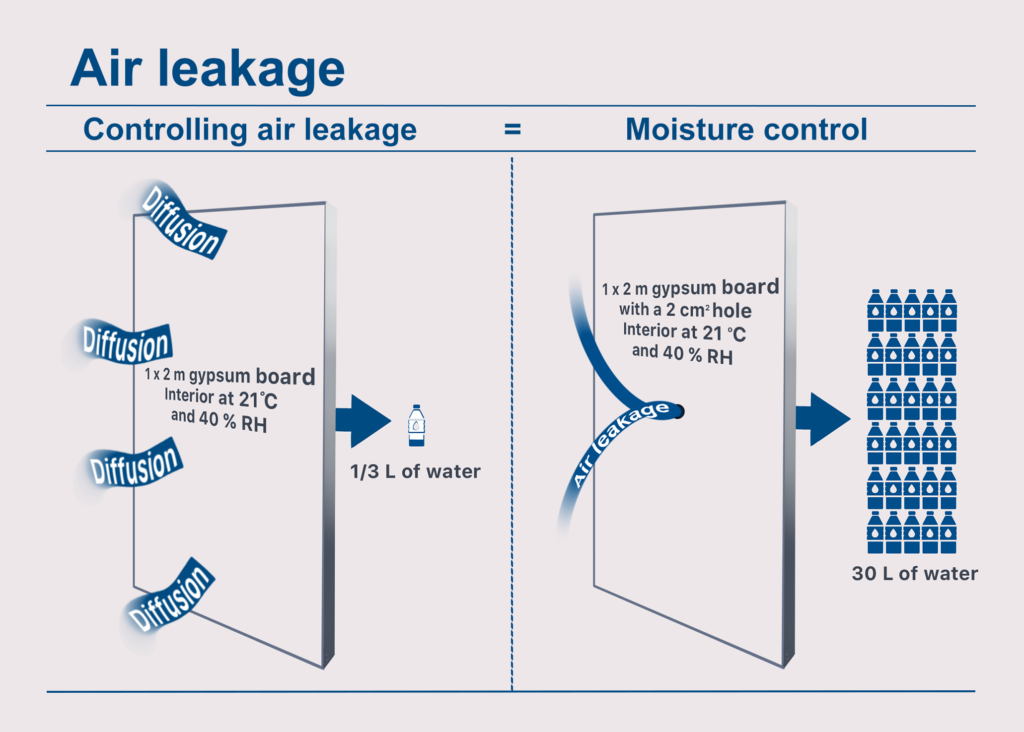
Controlling the flow of air is more important than controlling vapour diffusion. During a heating season, air leakage through a sheet of gypsum board with a hole in the middle will result in almost 30 L of water. Vapour diffusion through a solid sheet of gypsum board (i.e. no hole), however, will only result in 0.3 L of water (Source: Building Science Corporation)
Sealing a building’s air leaks prevents draughts from windows, doors, attics and floor boards, providing better indoor temperature control.
It has also been proven that beyond a certain thickness of open-cell and closed-cell spray foam, the airtightness requirements are met. Closed-cell spray foam can also meet vapour barrier requirements.
In areas with extreme climates, good indoor temperature control can have a dramatic effect on household comfort. Various studies have shown that up to 40 % of a building’s total energy losses are due to air infiltration. SPF adheres to the walls and floors and fills stud cavities to create a tight seal and insulating barrier that stops this air leakage.
Mould growth often occurs in the presence of excessive heat and moisture accumulation. Therefore, the most effective way to control indoor mould growth is to control moisture and SPF can be used effectively as an air and vapor barrier. When applied, SPF seals the cracks, gaps and holes in the building’s structure and sheathing to create a tight space by reducing air and moisture flow from infiltration and exfiltration.
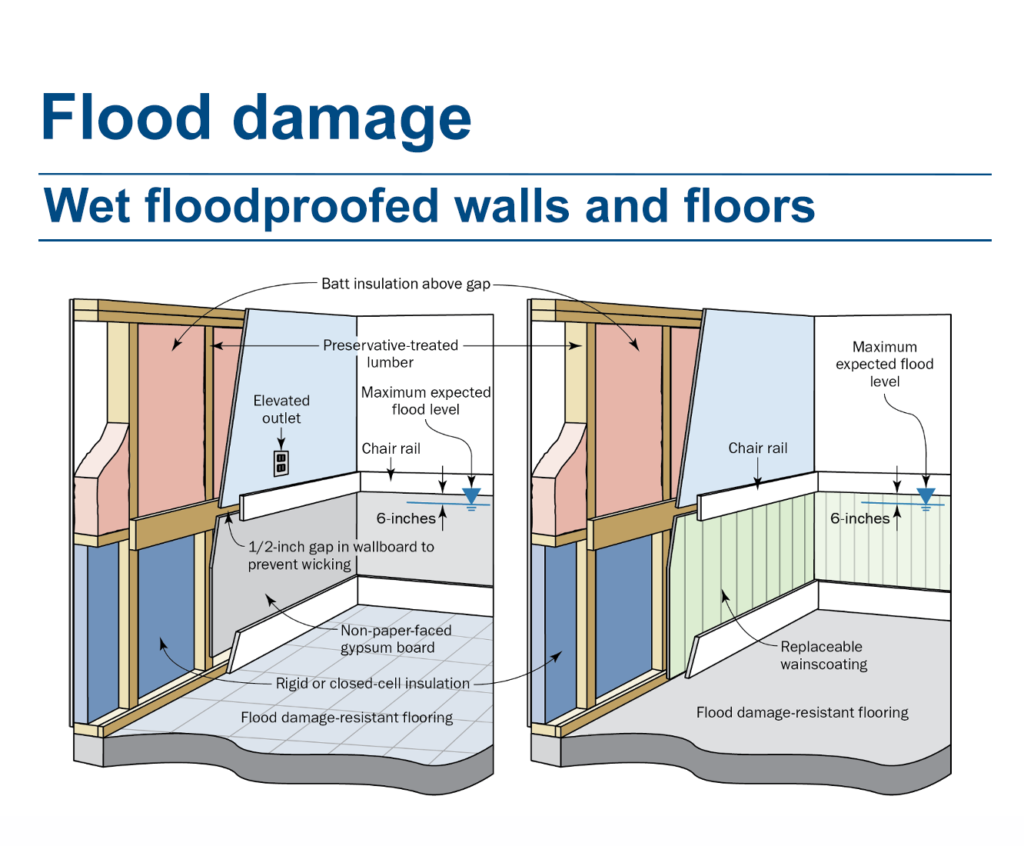
How flood damage-resistant materials can be used for finished walls and floors (Source: FEMA, Flood Damage-Resistant Materials Requirements, Technical Bulletin 2, January 2025)
Furthermore, SPF insulation can have a benefit on:
Sound transmission: Some manufacturers have developed products which can help with sound transmission reduction.
Pollen, dust and insects penetration: sealing gaps with spray foam can block them from entering the building via cracks and tiny spaces.
Closed-cell spray foam provides protection against radon and other soil gases when installed outside foundation walls and below the concrete slab.
When used below grade, closed-cell spray foam greatly reduces flood damage. The US Federal Emergency Management Agency (FEMA), which responds to natural disasters, has classified closed-cell SPF insulation as highly resistant to floodwater damage, saying: “These materials can survive wetting and drying and may be successfully cleaned after a flood to render them free of most harmful pollutants” (for more information, see here).