Considering most of the pressing environmental issues as defined in the most common methodologies (GHG emissions, water use, NOx emissions, PMs, gas leading to acidification, etc.), the environmental impact of Spray Polyurethane Foam production is much lower than the additional energy consumption (and therefore production) that would be required in its absence. In a typical home, it is estimated that the amount of energy used to produce its foam insulation products is recovered after only one year of use.(Source: PlasticsEurope)
Like other polyurethane insulation products, SPF products have very good performance-to-weight and performance-to-volume ratios, making them resource-efficient insulation materials. However, other characteristics specific to SPF contribute to its environmental performance:
SPF insulation is very efficient to transport since the liquids (high density) are brought to the construction site and the foam is manufactured on site (the volume of insulation produced can be 20 to 60 times greater than the liquid delivered).
Furthermore, since SPF is applied where it is needed, the amount of waste generated during its application is rather low.
Due to the durability of SPF/PUR used in construction, no maintenance or repair is required and the material can be recovered and given an extended life in a number of ways. There is a wide and growing range of options for dealing with SPF at its end-of-life, limiting its impact on the environment.
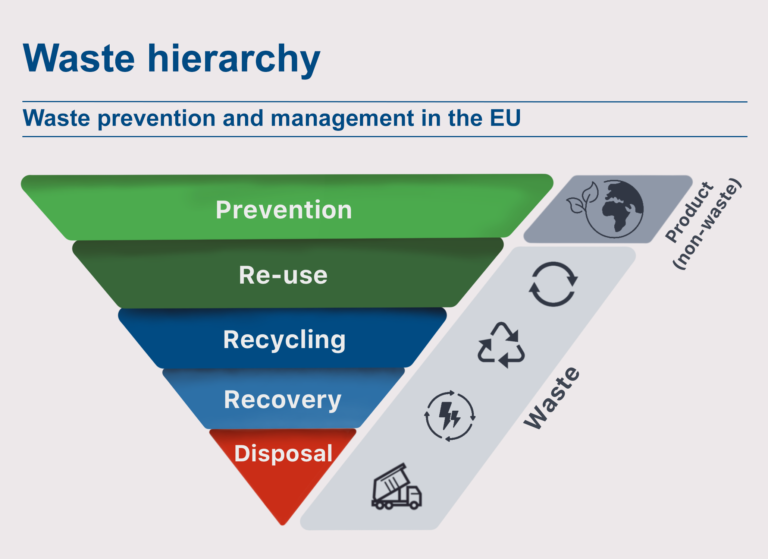
As with any material, careful planning for the end-of-life is essential to minimise its environmental impact. In line with the waste hierarchy principle, the SPF industry supports a range of strategies to extend material use and reduce waste — from prevention and reuse to both mechanical and chemical recycling.
Preventing waste is the preferred option, and sending waste to landfill should be the last resort
Prevention & preparing for re-use:
Thanks to its very low weight, which automatically reduces the use of resources, SPF can be used for thinner and lighter constructions, allowing savings on other materials, such as timbers, roof overhangs, etc.
In the case of renovation, the existing SPF layer can remain in place as the durability of the material is outstanding. An additional layer can easily be applied to further improve the thermal resistance of a structure, whilst keeping the original insulation
Great attention must be paid during the design phase on how to minimise waste during the spraying of PU and on the recovery of this material once the lifetime of the building is over
Re-use:
Thanks to its very stable properties (resistant to water infiltration, chemical attacks, mould, non-sagging), polyurethane insulation is suitable for re-use (in particular on the same building), provided that it is disassembled responsibly
Mechanical recycling:
Polyurethane insulation can also be shredded into particles and used, among other things, as a filler in insulating mortars or in combination with a binder processed into compressed boards
Chemical recycling:
A number of projects aim to implement, in the medium- and long-term, chemical (e.g., ammonolysis, glycolysis, hydrolysis) and other innovative processes, in order to be ready when significant volumes of PU begin to reach their end-of-life
Today it is already possible to manufacture a key raw material for polyurethane insulation, the polyol, from recycled PET bottles and other waste materials. This is already happening on a commercial scale, but will be scaled up in the coming years. Also, the other main component of SPF, the pMDI, can already be produced from renewable raw materials
Note on re-use and recycling: a more cost-effective way to collect Construction and Demolition Waste (CDW) is needed to make recycling more widespread. To this end, a joint effort from manufacturers and the whole supply chain is needed to ensure that a logistic infrastructure and recycling pathways exist.
Disposal/end-of-life:
The energy recovery of the hydrocarbons contained in SPF in waste-to-energy facilities will generate heat which can then be used in heating networks and for the production of electricity
Across the EU (plus Norway and Switzerland), more than half of plastics building and construction waste is being recovered and diverted from landfill through a combination of recycling and energy recovery (Source: PlasticsEurope)
Key developments in the industry:
Easily detachable SPF formulations for easy re-use and/or recycling at end-of-life
Further the use of alternative materials with a lower environmental footprint
Most PU Europe members provide Environmental Product Declarations (EPDs) which can be used when carrying out the environmental assessment of buildings. Even in low-energy buildings, the energy consumed during the use phase of the building contributes much more to global warming than the construction and insulation materials. The Life Cycle Assessment (LCA) of buildings shows the excellent contribution of plastics to reducing the environmental impact. For more information on EPDs please visit the For Professionals section of this website.
SPF insulation accounts for LEED V4 credits points:
Energy and atmosphere: improve energy performance
Indoor environmental quality: low-emitting adhesives and sealants